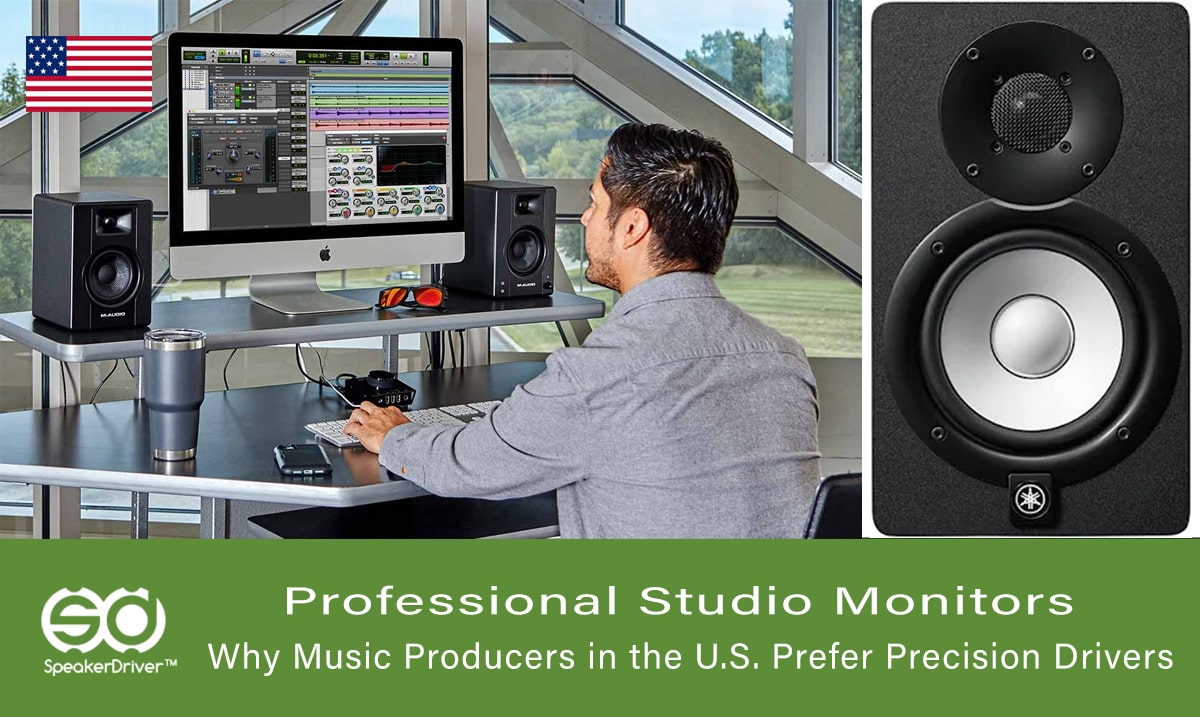

Professional Studio Monitors: Why Music Producers in the U.S. Prefer Precision Drivers
Professional studio monitors remain the reference tool for music producers, mixing engineers, and mastering professionals in the U.S. Unlike consumer speakers tuned for flattering sound, studio monitor speakers are built for accuracy — revealing every detail, balance, and imperfection in a mix. This precision lets creators make reliable production decisions that translate well across playback systems.
What Makes Studio Monitors Different?
- Neutral Frequency Response – Engineered to produce a flat, uncolored sound so mixes remain truthful.
- Precision Drivers – High-quality woofers and tweeters with tight tolerances for fast transient response.
- Accurate Imaging – Tight dispersion and controlled directivity allow clear stereo placement and depth perception.
- Amplification & DSP – Matched Class-D or Class-AB amplifiers and room-correction DSP for consistent performance.
- Build Quality – Rigid cabinets, carefully braced enclosures, and low-resonance materials reduce coloration.
Key Features Music Producers Look For
- Flat Response – Minimal tonal shaping to ensure mixes translate across systems.
- Low Distortion – Clean reproduction at varying SPLs for accurate level decisions.
- Wide Dynamic Range – Ability to handle quiet detail and loud transients without compression artifacts.
- Port or Sealed Enclosure Options – Choice affects bass extension and transient character depending on room and preference.
- Inputs & Connectivity – Balanced XLR/TRS, digital inputs (AES/EBU, S/PDIF, USB) and word clock for pro workflows.
Typical Technical Specifications
- Monitor Type: Near-field, Mid-field, or Main/FOH
- Driver Configuration: 2-way (woofer + tweeter) or 3-way designs for larger monitors
- Frequency Response: 35Hz – 20kHz (varies by model and size)
- Power: 50W–500W per speaker (active models)
- Inputs: Balanced XLR/TRS, RCA (consumer), Digital options on pro models
- Room Correction: Integrated DSP with calibration microphones on many modern monitors
Comparison — Studio Monitors vs Consumer Speakers
| Aspect | Studio Monitors | Consumer Speakers |
|---|---|---|
| Sound Tuning | Neutral / Flat for reference | Enhanced bass/treble for pleasing sound |
| Use Case | Mixing, mastering, critical listening | Casual listening, home theater |
| Imaging & Detail | High—precise stereo placement and micro-detail | Variable—often designed for wide sweet spots |
| Connectivity | Professional balanced and digital inputs | Consumer-friendly inputs and wireless options |
Use Cases — Who Needs Precision Drivers?
- Mix Engineers – To make mix decisions that translate well across systems.
- Mastering Studios – Require extremely low distortion and consistent reference response.
- Composer & Sound Designers – Need accurate transient reproduction and stereo imaging for placement and detail work.
- Project Studios – Higher-end nearfields bring professional transparency to independent producers.
How to Choose the Right Studio Monitors
- Room Size & Listening Distance – Near-field monitors suit small rooms; mid-field or multiples work better in larger control rooms.
- Driver Quality – Look for low-mass tweeters for fast high-frequency response and long-throw woofers for controlled bass.
- Amplification Matching – For passive monitors, pair with accurate power amps; for active monitors, ensure amp power suits SPL needs.
- Room Treatment & Placement – Acoustic treatment and correct positioning often improve results more than upgrading monitors alone.
- Feature Set – Consider room-correction DSP, boundary compensation, and input flexibility when selecting models.
Trends in Professional Audio Gear for Producers in the U.S.
The pro audio industry is seeing advances in DSP-driven correction, hybrid analog/digital signal paths, and compact high-performance monitors suitable for smaller studios. US producers increasingly favor monitors that combine precision drivers with onboard calibration tools — giving honest sound in imperfect rooms while keeping workflows efficient.
Recommended Listening Checklist for Evaluating Monitors
- Transient Test – Play percussion and fast attacks to judge driver speed and response.
- Sibilance & HF Detail – Check vocal highs for harshness or smearing.
- Low-End Control – Use bass-heavy tracks to assess extension and tightness (not just loudness).
- Mono Compatibility – Sum mixes to mono to ensure phase coherence and clarity.
For music producers, studio monitors are not a luxury — they are the primary measuring tool. Precision drivers reveal the truth of a mix so creativity can be translated into real-world results.